 Catchable
Learn / Lesson 4 of 6
Let it go the right way
Keep the fish in the water, wet your hands, and let it swim away on its own. Follow the gear rule on the card.
The official source wins. This page explains. The official pages at the bottom decide.
Why
- Many fish you catch must go back: a fish that is too small, a wild salmon where only hatchery fish may be kept, or any fish in catch and release water.
- A fast release at the water gives a fish its best chance. Time in the air, dry hands and a long fight make it harder for the fish to recover.
- Rockfish brought up from deep water swell up and need help to get back down.
What to do
-
Use the gear the card names. If it says barbless, crimp the barb flat or cut it off.
Because barbless hooks make it easier to release a fish and cause less damage.
-
Wet your hands before you touch the fish.
Because the slime and scales protect the fish, and dry hands and hard, dry surfaces can damage them.
-
Keep the fish in the water if you can. If you must use a net, use a soft knotless mesh net.
Because a net can damage a fish's scales and fins, and soft knotless mesh does less harm.
-
Take the hook out gently. If it is deep, cut the line close to the hook.
Because pulling out a deep hook can do more harm, and the hook is likely to fall out by itself.
-
If you are in a boat and catch a rockfish you will not keep, use a descending device to send it back down.
Because it is a condition of licence for anglers in vessels, and it returns the fish to a similar depth to where it was caught.
The official words
In short, in our words
DFO sets the gear and release rules for salt water, such as barbless hooks. The Province sets them for lakes and rivers. Rockfish conservation areas have rules of their own.
- Fisheries and Oceans Canada: salmon fishing information
- Fisheries and Oceans Canada: finfish (other than salmon) fishing information
- Fisheries and Oceans Canada: improving the survival of fish released in tidal waters
- Fisheries and Oceans Canada: protecting rockfish
- Fisheries and Oceans Canada: rockfish conservation areas
- Province of BC: freshwater fishing regulations
Last checked against the pages above on . The salmon page says it was last modified on , the finfish page on , the release survival page on , the rockfish page on and the restricted areas page on . The Province of BC page says it was last updated on .
Try it in Catchable
When a card says NON-RETENTION, DFO's word for catch and release, you may fish, but the fish goes back. Open Gear on the same card for the gear rule.
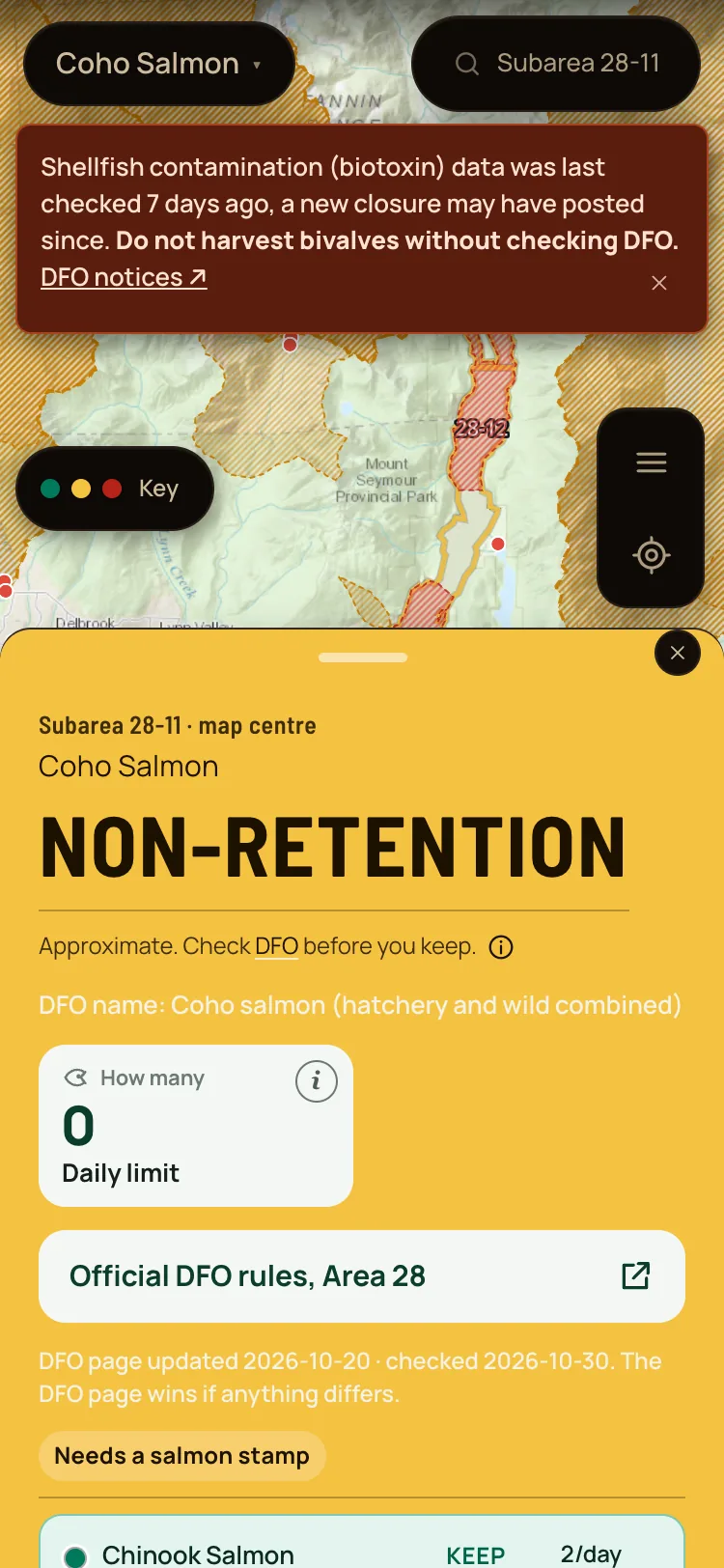
Subarea 28-11
Coho salmon Catch and release
NON-RETENTION means catch and release: you may fish, but every coho here goes back.
Captured in Catchable on . Map: Esri, USGS, NOAA, and OpenStreetMap contributors.
Where do I let a fish go? Back where you caught it. DFO says the law requires a released fish to go back in a way that causes the least possible harm.
Next: Cold water and your lifejacket